For corporate travel managers, coordinating executive chauffeur travel means aligning the itinerary, vehicle, passenger communications and company policy before the journey begins. We orchestrate complete travel experiences, not just transport, so clear details and dependable handoffs are essential to a seamless day.

Key Takeaways
- Build the journey around a complete itinerary. Include passenger, timing, location, flight and stop-by-stop details, then allow room for traffic and meeting changes.
- Give every handoff an owner. Decide who can change a booking, who contacts the provider and who verifies that revised arrangements have been received.
- Choose a vehicle for the actual load. Count people and bags separately, then match capacity and comfort to the purpose of the trip.
- Set a specific airport meeting plan. Agree whether the pickup is kerbside or inside arrivals, and define how flight updates will reach the provider.
- Protect passenger details. Limit itinerary access and share support needs only with the people responsible for providing the journey.
- Record cost and performance consistently. Consistent trip records support policy checks, billing reconciliation and better service reviews.
- Explore relevant planning guidance. Our corporate travel articles cover executive transport and related journey planning.
Start with a complete executive itinerary
A precise executive itinerary gives the booking team and chauffeur service a dependable starting point. Missing a mobile number, using an incomplete address or confusing a pickup time with an arrival deadline can mean a missed connection or a vehicle waiting at the wrong place.
For every journey, provide:
- The passenger’s name, passenger count and mobile contact.
- The travel date, full pickup and drop-off addresses, and the time the passenger must reach each destination.
- For airport transfers, the flight number, terminal and whether the booking is for an arrival pickup or departure drop-off.
- For roadshows and multi-stop days, each stop in sequence, expected time at each location and any meeting times that cannot move.
Build in slack for traffic, airport procedures and meetings that overrun. Allow a longer schedule when the route or day’s appointments demand it; an itinerary with no breathing room can put every subsequent commitment at risk.
For a roadshow, separate fixed appointments from flexible stops before the route is arranged. This makes it easier to coordinate the sequence, identify where the schedule is tight and adjust the plan before the executive is on the move.

Agree service standards and booking ownership
A corporate car service should be booked against a defined journey, not a generic request for a car. Specify whether the executive needs an airport transfer, a business-meeting transfer or a series of city journeys so the booking reflects the itinerary from the outset.
Set out the handoff in writing: who places the booking, who may amend it, who sends changes to the provider and who checks that the revised pickup plan has been received. A named owner at each step prevents an updated time or address from disappearing between an assistant, travel team and provider.
Before approval, agree the chauffeur standards that matter to your organisation. Define expectations for punctuality and dispatch availability, along with the escalation route for a missed pickup or vehicle issue; when it comes to executive and corporate logistics, the margin for error is essentially zero.
LPB Chauffeurs’ luxury chauffeur services cover corporate events, business meetings, airport transfers and city travel. That range illustrates why a corporate travel plan should identify the service needed for each itinerary rather than treat every booking as the same type of journey.
When reviewing a London chauffeur service, make your standards operational: say how the provider should receive an amendment, which contact should respond on the day and how your team will know that the change has been actioned. That clarity supports both the booking team and the passenger.
Did You Know?
A large majority of travel managers (82%) said their company’s travel policy at least sometimes permits chauffeured transportation.
Source: Global Business Travel Association and National Limousine Association
Match the vehicle to passengers, luggage and purpose
Vehicle suitability begins with a separate count of passengers and bags. Include cabin luggage, larger suitcases and work equipment, because the number of passenger seats alone does not tell you whether the full load can be accommodated comfortably.
The Senzati Jet-class is a premium van for five passengers and four luggage bags, listed at £100 per hour with a three-hour minimum. Its reclining leather seats with massage function, individual entertainment screens, privacy partition, refrigerated bar and premium sound system make it a considered option for a group whose journey calls for space and onboard comfort.
Match features to the purpose of the trip as well as the load. A longer working journey may benefit from a quiet, comfortable environment, while a short transfer may call for a straightforward configuration; the right choice serves the passenger’s needs without adding unnecessary complexity.
For group travel or a schedule using multiple vehicles, assign each passenger and bag to a specific vehicle in advance. That simple allocation helps the group leave together and avoids last-minute rearrangement at the kerb.
Coordinate airport pickups and live updates
An airport pickup needs a clear meeting instruction. State whether the passenger will meet the chauffeur at the kerb for a curbside pickup or inside the arrivals terminal, since these are distinct arrangements and vague directions can leave both parties waiting in different places.
Provide the flight number and assign one person to communicate delays, diversions or revised arrival details to the provider. That person should also verify the updated pickup plan and make sure the passenger knows where to go.
Agree the dispatch contact, the passenger-facing contact and the channel for day-of updates. An explicit communication plan gives the travel manager a reliable route for resolving a change.
LPB Chauffeurs’ Meet & Greet Service can include flight monitoring, an inside-terminal meeting where requested, luggage assistance and an escort to the waiting vehicle. This arrangement suits passengers who need a defined arrival handover rather than an unaccompanied walk to a kerbside pickup.

Protect passenger information and prepare for disruption
Share only the passenger and itinerary details required to arrange and deliver the journey. Restrict access to sensitive executive travel information, and establish a clear retention and deletion practice so details do not remain available longer than your process requires.
Record accessibility, mobility, language or other support needs discreetly. Route those details only to the staff who need them to provide the service, preserving passenger privacy while giving the right people the information needed for thoughtful care.
Prepare a contingency plan for a missed pickup, vehicle problem or route disruption. Name the first contact, a backup contact, the person authorised to approve replacement arrangements and the escalation point if neither contact responds; relying on a single person leaves the response vulnerable if that person is unavailable.
After an incident, record what happened, how quickly the team responded and the outcome using consistent categories. Reviewing those records helps identify recurring service issues and gives travel managers a sound basis for improving future arrangements.
Did You Know?
Over three-fourths (76%) of travel managers said chauffeured transportation was often permitted for executives.
Source: Global Business Travel Association and National Limousine Association
Confirm policy, billing and post-trip review
Before approval, check the booking against company travel policy and identify the authorised spend, cost centre, billing contact and receipt or invoice requirements. Clear rules make corporate travel expense management more straightforward for the travel team and finance colleagues.
Agree how waiting time, cancellations, surcharges and itinerary changes are handled, and name the person who can approve additional costs. When these terms are clear before travel, billing reconciliation is easier and the executive is less likely to be caught between teams over an unplanned change.
Record each journey using consistent fields, such as itinerary, cost, service outcome and incident details. Comparable records let travel and finance teams review spend and service performance on the same basis, rather than trying to reconcile different formats after the fact.
A survey by the Global Business Travel Association and National Limousine Association found that only 63% of travel managers surveyed knew how much of their company’s overall travel spend was devoted to ground transportation. Journey-level records give your organisation a clearer view of this category and make review more useful.
Company policy should also say which journeys qualify, how approval works and what documentation is needed. The chart below presents survey findings on when chauffeured transportation was often permitted for executives and board members.
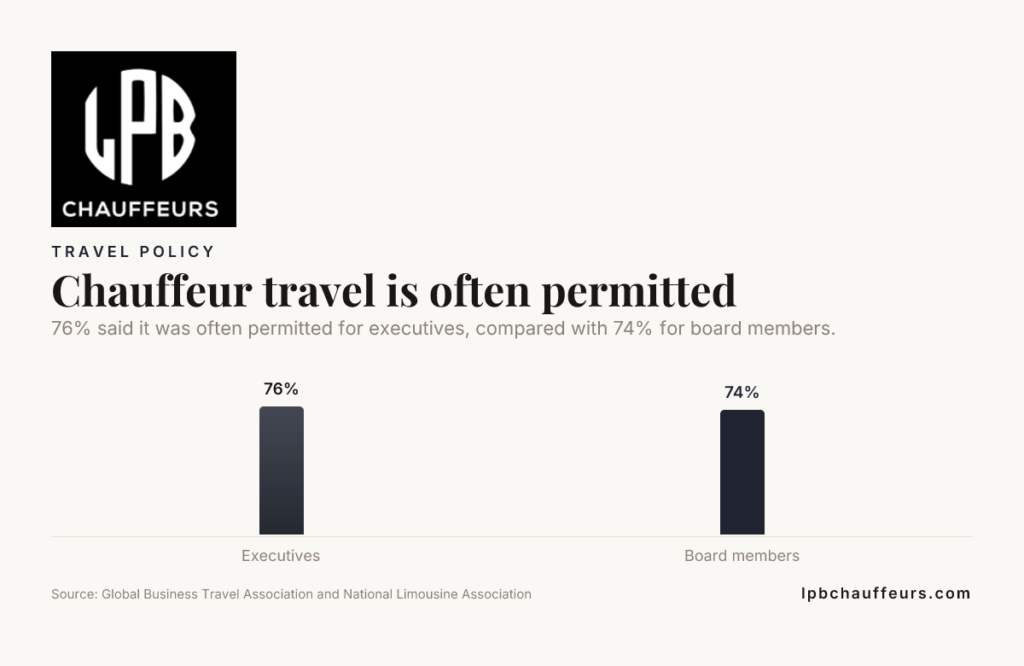
76% said it was often permitted for executives, compared with 74% for board members.
Source: Global Business Travel Association and National Limousine Association

Frequently Asked Questions
How far in advance should a corporate chauffeur journey be booked?
Book once the itinerary is stable enough to approve, and allow more lead time when the journey involves several stops, a group or a high-demand travel period. Early booking also gives the team more time to resolve special arrangements before the travel day.
Can a travel manager arrange a recurring chauffeur booking on a standing schedule?
Yes, a recurring schedule can suit regular executive journeys. Keep a controlled record of the usual pattern and review it when the passenger’s working arrangements change, so a standing instruction does not continue after it has become outdated.
Should an executive receive the chauffeur’s direct contact details before the journey?
Where your organisation’s privacy procedures allow it, share the relevant day-of contact through an approved channel and explain when it should be used. Some companies may prefer the executive to contact a central travel or dispatch desk, particularly when they need a consistent record of communications.
What should a travel manager do if an executive needs to change the destination after the journey has started?
Ask the executive to communicate the change through the agreed contact route, then have the provider confirm the revised destination and any effect on the route or fare. The chauffeur should follow the updated instruction only once the change has been relayed through the appropriate operational channel.
How should a company decide which chauffeur journeys qualify under its travel policy?
Define eligibility using clear criteria such as approved traveller groups, journey purpose and any relevant duty-of-care or accessibility considerations. Give approvers a consistent way to record exceptions, so similar requests receive consistent decisions.
Checklist
Reliable executive ground transportation depends on accurate itinerary details, clear booking ownership, suitable vehicles and an agreed process for airport updates or disruption. A Checklist for Coordinating Executive Chauffeur Travel helps bring those decisions together, from the first booking through billing reconciliation and post-trip review.
Set standards your team can apply consistently, protect passenger information and record outcomes in a useful format. With the right handoffs in place, we can orchestrate a seamless chauffeur journey that reflects the care and attention to detail your executives expect.
Book Your Executive Transport Today
Experience Luxury travel with LPB Chauffeurs. Arrive in style, we’re ready to provide a comfortable, punctual, and luxurious ride. Reserve now and travel with confidence.